

Sustainable Futures: Building Resilient Societies Through Innovation and Justice
Sustainable Futures is more than a phrase for policy makers or planners. It is a practical framework that shapes how communities, businesses and governments plan for long lasting prosperity while protecting the planet. In this article we explore the core ideas that drive Sustainable Futures and offer clear actions that leaders and citizens can take now to bring those ideas to life.
What Sustainable Futures Mean
At its core Sustainable Futures refers to the deliberate design of systems that meet present needs without diminishing the ability of future generations to meet their own needs. That idea covers natural resources social fairness economic stability and healthy ecosystems. A true Sustainable Futures approach balances those priorities so that energy food shelter and mobility are affordable accessible and regenerative.
Sustainable Futures recognizes that environmental limits are real while social aspirations are legitimate. It rejects short term fixes in favor of strategies that create durable value for people and for the biosphere.
Key Drivers of Sustainable Futures
Several major forces shape successful Sustainable Futures:
1. Energy transformation toward low emission sources that can scale quickly
2. Urban planning that increases density while preserving green space
3. Circular resource systems that extract more value and create less waste
4. Finance that directs capital to resilient infrastructure and inclusive services
5. Governance that integrates science technology equity and accountability
Each driver interacts with the others. For example cleaner energy reduces pollution and improves health which in turn lowers public health costs and increases productivity. Integrated planning amplifies these gains and builds an economic case for long term investments.
Energy Transition and Decarbonization
A reliable energy transition is central to Sustainable Futures. Deployment of renewable energy sources must be matched with improvements in grid resilience energy storage and efficiency. Policies that encourage distributed generation and community owned projects can both reduce emissions and spread economic benefits.
Energy efficiency in buildings industry and transport is a high impact area. Simple upgrades in insulation lighting and control systems combined with smart demand management reduce costs and free up power for new uses. Investing in electrification of transport and heat paired with renewable generation is a proven pathway to deep decarbonization.
Urban Design and Mobility
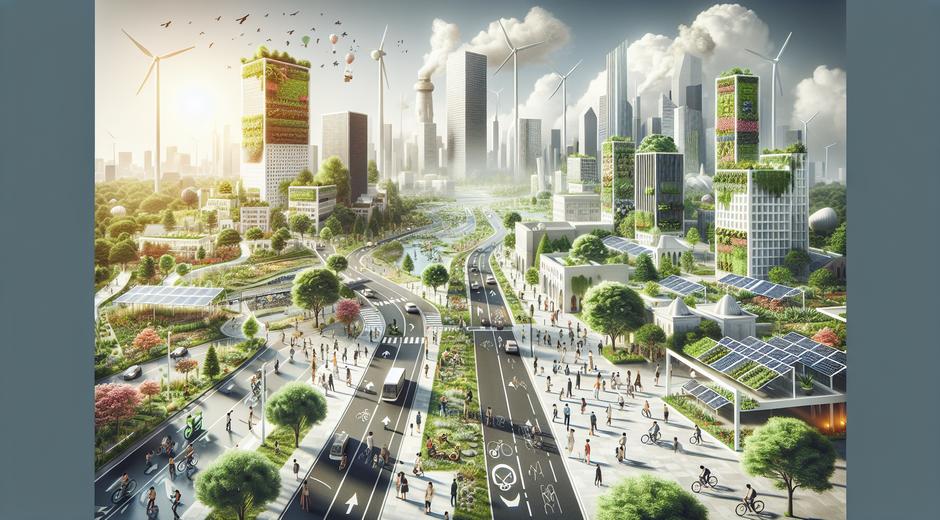
Cities will define the quality of many Sustainable Futures. Compact mixed use neighborhoods reduce travel distances and support local economies. Well designed public transport networks cycling and pedestrian infrastructure improve access and reduce congestion. Urban green spaces support biodiversity reduce heat and improve human wellbeing.
Smart zoning land use and investments in affordable housing are all part of a systems based approach to Sustainable Futures. When cities plan for resilience they also plan for economic opportunity and social inclusion.
Circular Economy and Resource Stewardship
Moving beyond linear take make dispose models is essential. Circular systems focus on reuse repair remanufacture and recycling to keep materials in productive use. Redesigning products for longevity and modular repair reduces waste and creates new business models.
Industrial symbiosis where one company uses the waste of another is a practical example of circular thinking. Municipal programs to increase composting and reduce landfill reliance provide local jobs and restore nutrients to soils.
Finance Policy and Governance
Capital allocation is a powerful lever for Sustainable Futures. Green bonds climate resilient infrastructure funds and impact investment can shift trillions into sustainable projects. Public policy needs to create stable long horizon signals so private investment can flow with confidence.
Regulatory frameworks that incorporate environmental social and governance criteria help align market incentives with public goals. Transparency and robust metrics ensure accountability and enable course correction.
Community Action and Education
Lived experience and community leadership are necessary for Durable Sustainable Futures. Education that equips people with knowledge and practical skills empowers local innovation. Community led renewable projects local food systems and neighborhood resilience hubs illustrate how grassroots action scales.
For readers seeking a broad overview of global reporting and community driven initiatives visit ecoglobalo.com where diverse perspectives are highlighted and resources are shared.
Technology and Data for Good
Technology is a tool not a panacea. Data driven planning remote sensing and predictive modeling improve decision making for resource management and disaster response. At the same time privacy ethics and equitable access must be core design principles.
Digital platforms that aggregate local data can help cities optimize services reduce energy waste and target social programs more effectively. But technology must be deployed to support human wellbeing and ecosystem stability rather than driving consumption alone.
Measuring Progress
Robust metrics are essential. Sustainable Futures requires indicators that capture environmental health social equity and economic resilience. Traditional GDP measures are insufficient on their own. Composite indicators natural capital accounting and wellbeing measures help form a fuller picture.
Regular transparent reporting backed by independent review encourages continuous improvement. Measurement also helps reveal which investments deliver the greatest long term value.
How Individuals and Organizations Can Act Today
There are practical steps that individuals businesses and institutions can take to accelerate Sustainable Futures:
1. Align procurement and investment decisions with long term environmental and social outcomes
2. Adopt energy efficiency measures and shift to cleaner energy sources
3. Support circular design principles in product development and operations
4. Engage in local planning processes and advocate for equitable infrastructure
5. Invest in education workforce training and community based resilience initiatives
Collective action magnifies impact. Organizations that collaborate across sectors can unlock systemic change and scale proven solutions.
Case Examples That Inspire
Across the world many examples show Sustainable Futures in action. Community owned solar cooperatives increase energy access and local wealth. Cities using nature based solutions reduce flood risk and sequester carbon. Small businesses that prioritize repairability and reuse build loyal customer bases while reducing costs.
These examples highlight that Sustainable Futures works at every scale and often yields economic as well as environmental benefits.
Conclusion
Sustainable Futures is an agenda for action that blends technology policy finance and community leadership. It asks leaders to plan with long horizons and asks citizens to support systems that are fair and resilient. The path ahead requires ambition but it also offers clear opportunities for innovation prosperity and wellbeing.
For organizations seeking promotion or partnership to amplify Sustainable Futures messages and campaigns visit Ecoglobalo.com to learn about collaboration options and featured initiatives.
Sustainable Futures is not a single program. It is a way of thinking and acting that aligns many parts of society toward shared goals. With coordinated effort the coming decades can deliver cleaner air healthier communities and steady economies that respect planetary limits and human dignity.